
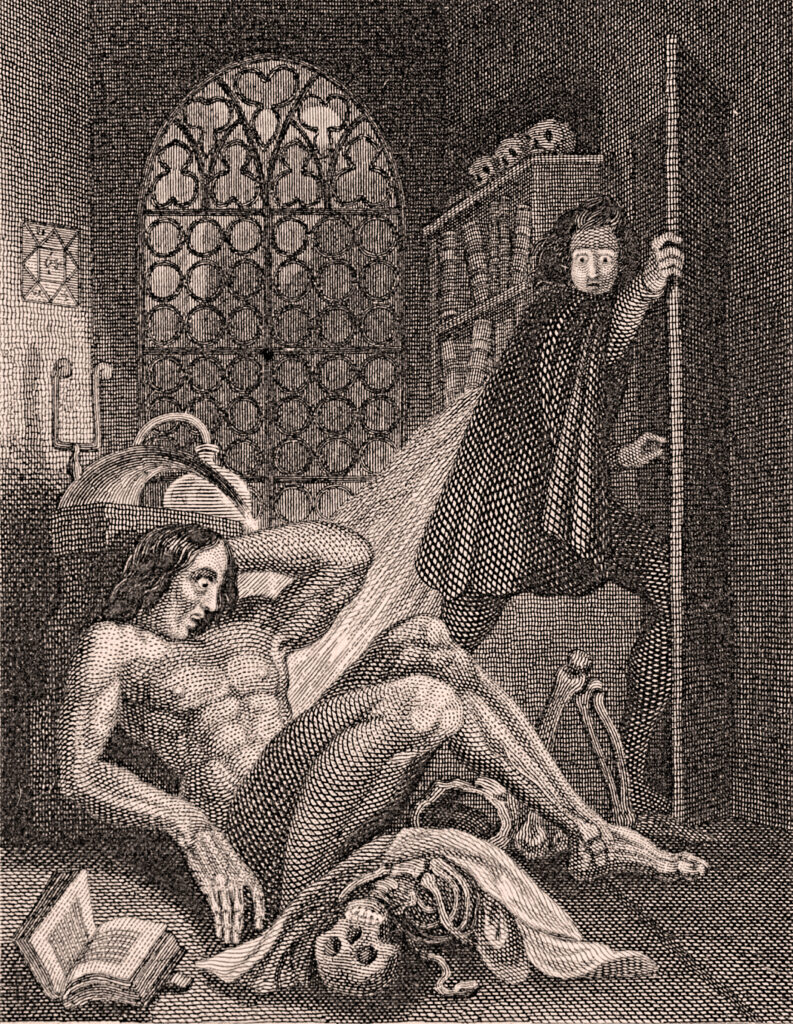
Frankensteinism, or Catastrophe Old and New: Reading Mary Shelley Today
Mary Shelley was only 18 years old when she dreamt her Modern Prometheus, or Frankenstein, in the midst of Lord Byron’s ghost story competition in Geneva during the summer that wasn’t of 1816. Over the two centuries since its publication, this “Modern Prometheus” has been read as a cautionary tale regarding the pitfalls of techno-scientific hubris, invoked in regard to the atomic bomb or genetic engineering, for example, which it is in part.
In the twenty-first century, a new Frankensteinism has taken hold among the digital overlords of Silicon Valley. Our neo-Frankensteins include techno-capitalists from Elon Musk and Peter Thiel to Ray Kurzweil and Sam Altman in addition to transhumanist fellow traveler Bryan Johnson, who draws on the blood of his son in a techno-Gothic flourish worthy of Shelley (or perhaps Bram Stoker). These transhumanist Frankensteins explicitly pursue immortality and divinity, as they strive to build indestructible bodies or merge with their supercomputers; preferably on their own high-tech floating island, or perhaps off-world, as the earth and its masses burn in a climate catastrophe entirely due to the depredations of industrial capitalism and its growth imperative.
Mary—one of the few significant romantic novelists, whose work was nonetheless until recently dismissed as the minor contribution of a woman plagiarizing husband Percy Shelley or father William Godwin—then went on to write what is arguably the first cli-fi or eco-catastrophe novel: The Last Man (1826). It’s as if this second generation romantic and regency era writer is our contemporary—at least that is the central starting point and conceit for this course.
We will begin with Mary Shelley’s predecessors and contexts—including her pioneering feminist mother Mary Wollstonecraft, Godwin, and Shelley—before moving on to Frankenstein and The Last Man. We will read these novels alongside contemporary treatments of transhumanism, cyborg “ontology,” and the ecological crisis.
We believe cost should not be a barrier to participation. Two sliding scale seats are available in all BFI seminars — contact us to inquire.
Registration not yet open.