
Plato’s Republic: Justice and the Good Life
“Unless the philosophers rule as kings or those now called kings and chiefs genuinely and adequately philosophize, … there is no rest from ills for the cities, my dear Glaucon, nor I think for human kind.” — Socrates, The Republic
What does it mean to live justly? Is justice something we pursue for its own sake, or merely for the benefits it accrues? Is there a universal standard of justice, or is it relative to time and place? Plato’s Republic begins with such questions and rapidly expands them into one of the most ambitious works of political and moral philosophy ever written. It is at once a dialogue, a theory of knowledge, a critique of democracy, the first true utopia, and an extended meditation on the costs of the philosophical life.
In this seminar, we will read the Republic slowly and intensively, treating it as both a work of political theory and a literary construction. Plato is a deliberate and meticulous writer. His use of the dialogue form is no mere gimmick, but a conscious attempt to implicate the reader in the discussion itself. Hence, we will attend to the dramatic texture of the text, the ironies embedded in Socrates’ method, and the silences and capitulations of his interlocutors. Plato raises concerns that remain of central importance for contemporary politics, including the relationship between justice and happiness; the proper role of expert knowledge in governance; the influence of education, art, and censorship in shaping virtuous citizens; the use of social engineering to promote healthy psychology; the proper organization of labor, property, and family life; and the tension between philosophical truth and political necessity. We will assess, moreover, some of Plato’s most consequential ideas, including the theory of forms, the divided line, the noble lie, and the allegory of the cave.
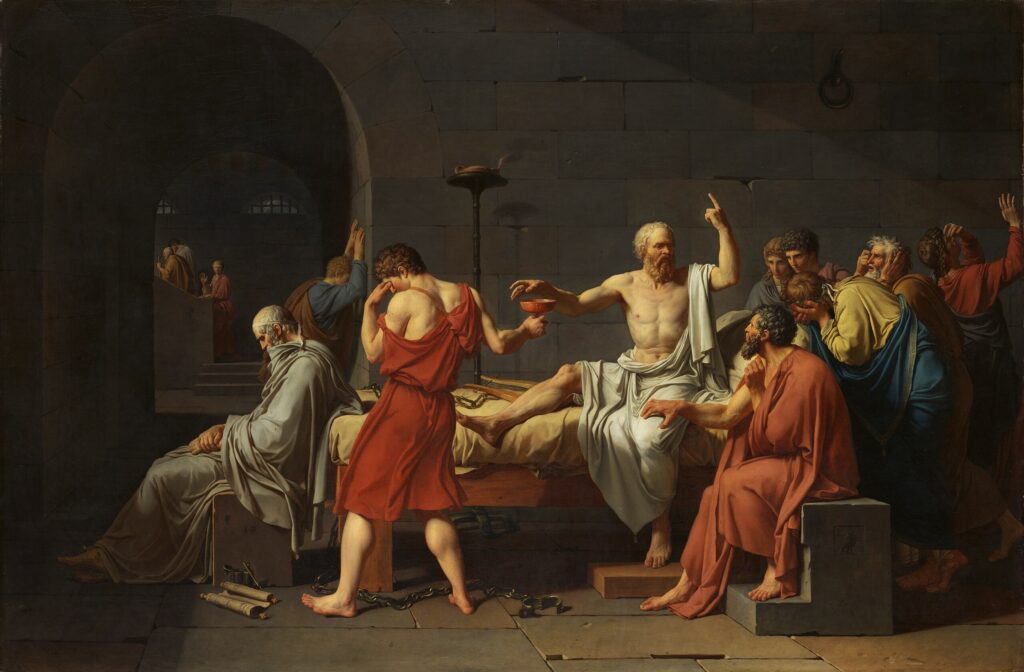
We will also come to be acquainted with Socrates himself, the gadfly of Athens, frequently as irritating as he is insightful. What kind of life does philosophy demand? Is it compatible with politics, or fundamentally at odds with it? Socrates famously insists that philosophers would make the best rulers. Yet no one who reads the text—either now or in Plato’s time—can ignore the fact that Socrates was himself tried, condemned, and executed by the Athenian democracy on bogus charges. This tension underlies every argument in the dialogue, and we will return to it throughout the course. What might Plato’s unsettling vision have to teach us about the possibilities and limits of justice in our own time?
To orient our reading historically and philosophically, we will begin with the political context of fifth-century Athens: the aftermath of the Peloponnesian War, the trial and death of Socrates, and the fragility of Athenian democracy. We will also draw on a range of responses to Plato, from Aristotle to the twentieth-century Platonists, Simone Weil and Iris Murdoch.
We believe cost should not be a barrier to participation. Two sliding scale seats are available in all BFI seminars — contact us to inquire.