Online seminar / Begins February 7
Paradise Lost: Sovereignty, Power, and Free Will
“Better to reign in Hell than serve in heaven!”
Begins February 7 · Sundays, 2:00 PM—5:00 PM ET · $300 Dates & registration ↓
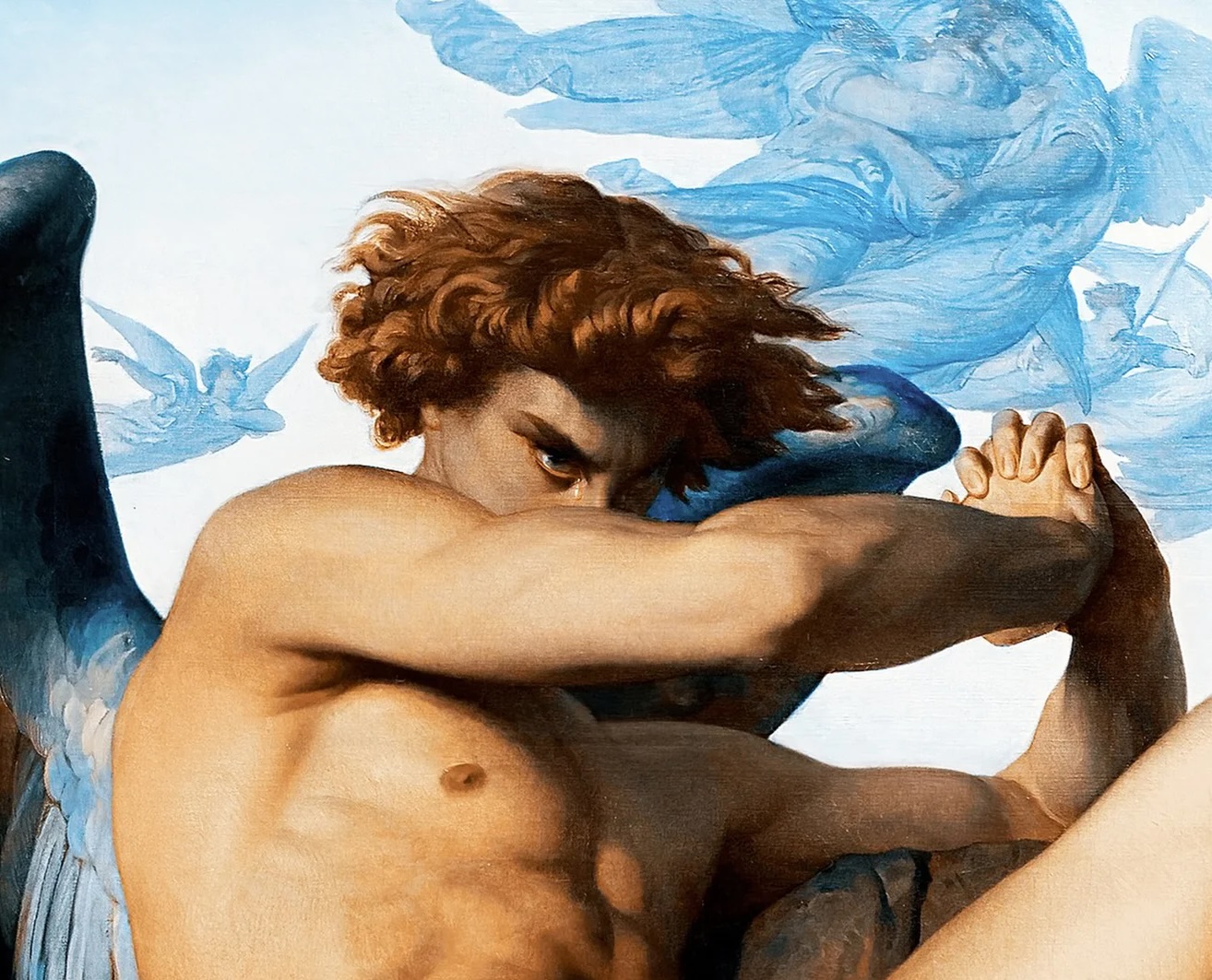
So Satan famously declares in John Milton’s Paradise Lost, the most influential epic poem written in the English language. While Milton claims that his goal in Paradise Lost is “justify the ways of God to men,” the poem has fascinated centuries of readers with its depiction of Satan himself, a compelling anti-hero who has served as a model for authors as diverse as Mary Shelley, Herman Melville, and Philip Pullman. Milton’s narrative coupling of the fall of the rebel angels with the fall of man significantly reinvents key elements of Christian mythos, reimagining the relatively simple story of disobedience in Genesis 2-3 as a complex interplay of divine, hellish, and human wills, played out across multiple planes of reality.
Written in the aftermath of the English Civil War and into the early years of the Restoration, Paradise Lost is keenly attuned to the struggles for sovereignty of subjects within both monarchic and parliamentary political systems. Milton’s own writing—including key essays on the right to divorce, on the right of Parliament to prosecute and execute Charles I, and against censorship of the press—placed him at the center of the seventeenth-century struggles between King and Parliament, and between the Church of England and the Protestant Dissenters who came into power in the late 1640s. A member of Oliver Cromwell’s revolutionary government throughout its decade-long tenure, Milton brings his acute awareness of the struggles for and of power to the writing of Paradise Lost, creating an endlessly engaging meditation on liberty, sovereignty, personality, and choice within his theological epic.
In this seminar, we’ll read Paradise Lost in its entirety, with optional supplementary readings both from Milton’s own writing and from contemporary scholarship. As we read, we’ll pay particular attention to questions of sovereignty, power, and hierarchy as they appear in both the heavenly and earthly realms, and we’ll interrogate Milton’s understanding of free will, a central concern of this poem at both the theological and the narrative level.

Your instructor
MC Hyland
MC Hyland (she/they) is a poet, publisher, scholar, teacher, and public artist. She is the author of three full-length books of poetry (most recently Walks & Weathers, 2025) and a collection of short essays (The Dead and the Living and the Bridge, also 2025). Their hybrid book of poetry and lyric criticism, A Book of Borrowed Light, is forthcoming from Thirdhand…
Full profile →