
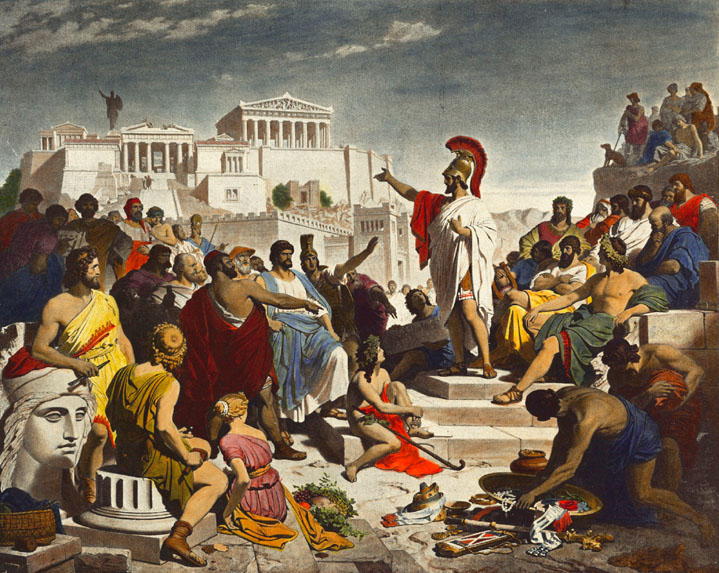
Athens Defeated: Thucydides and the Peloponnesian War
Are democracy and imperialism compatible? What kinds of leaders succeed in a democracy during wartime? How do states make decisions under pressure, and how do they justify those decisions to themselves and to others?
In this seminar, we will read The History of the Peloponnesian War in its entirety, while asking large questions of this remarkable text. Thucydides was an Athenian general in the 5th century BCE when the city-state of Athens declared war on its long time rival and long time ally of Sparta. After his failure at the battle of Amphipolis, he went into exile and wrote a history of this 28 year long war, which ended with the democratic Athens losing to the oligarchic Sparta. Despite dying before he could finish his history, on the strength of his political insight, historiographical rigor and coolly operatic style, his text would become, in his own words, “a possession for all time”.
We will read Martin Hammond’s translation. Because Thucydides took questions of style and precision seriously, we will supplement this translation with brief selections from others in order to grapple with difficult passages in which Thucydides’ intended meaning is not obvious. Furthermore, we will avail ourselves of maps and images of material culture in order to better understand Thucydides’ description of Greek life, politics and war.
While the seminar will necessarily attend to the historical conflict between Athens and Sparta, we will also use close reading of the text itself to ask more universal questions concerning power, justice and the purpose and proper method of writing history. Discussion will be driven by the text, with participants encouraged to bring their own questions and points of tension into the seminar as the inquiry unfolds.
We believe cost should not be a barrier to participation. Two sliding scale seats are available in all BFI seminars — contact us to inquire.
Registration not yet open.